

Experiment 3 Coordination game: Investment
What strategic considerations drive investment behaviour and coordination? Students, grouped in pairs, must choose simultaneously whether to invest or not under different frameworks. A simple coordination game reveals the relevance of the framing context.
CORE projects
The experiment is covered in:
- Section 4.13 in The Economy 2.0: Microeconomics
- Section 13.7 and Section 4.13 in The Economy 1.0
- Section 3.12 in Economy, Society, and Public Policy
Concepts in the experiment are related to material in:
- Unit 4 in The Economy 2.0: Microeconomics
- Unit 3, Unit 13, and Section 31.3 in The Economy 1.0
- Unit 2 in Economy, Society, and Public Policy
3.1 Introduction
What strategic considerations drive investment behaviour? How is the investment behaviour of a firm connected to the investment decisions of other firms? When deciding the level of investment, a company A considers not only its individual calculations, but also its expectations of company B’s investment. It is equally important what company A thinks about company B’s expectations of company A. In such situations, firms may coordinate on many different equilibria, and subjective factors play an important role. If investors are optimistic, they will make the investment and infect others with their optimism. If a pessimistic mood dominates, companies coordinate towards the no-investment equilibrium. That makes investments the most volatile component of aggregate demand.
This experiment is a coordination game with an investment frame. Students are grouped in pairs and have the choice to invest or not. If both players invest, they reach the highest payoff. But if one player invests while the other does not, the investor’s payoff is reduced to zero. The experiment is played with two different framings, which students are not informed about before the experiment. Groups are told that they are investors in one of two different countries. This framing influences the investment behaviour and may promote one of the equilibria. The two countries can be chosen freely by the instructor.
Experimental evidence shows that participants find it difficult to coordinate their investment decisions but perceptions about favourable investment circumstances help to improve coordination. This finding is in line with the observation in The Economy 1.0 Figures 13.19a and 13.19b that stable investment conditions help to solve the problem of selecting between multiple equilibria. Students experience the problem of such a multiplicity and how hard coordination is in such a case. They also observe how different framings can help or hinder coordination. They can use these insights to explain the volatility of investments in the real world.
You may find it useful to read about the experiences of instructors before getting into the detail of setting up the experiment, especially if you are new to running classroom experiments.
The experiment is based on Johann Graf Lambsdorff and Marcus Giamattei. 2020. Macroeconomics. Lecture in Economics.
How to cite this experiment
Giamattei, Marcus, Johann Graf Lambsdorff and Humberto Llavador (2021). ‘Coordination game: Investment’. Experiment 3 in The CORE Team, Experiencing Economics. Available at https://www.core-econ.org/experiencing-economics/experiments/03-coordination-game-investment.html [Accessed on (date)].
Key concepts
This experiment will help students understand the following key concepts:
- Coordination game
- Volatility of investments
- Expectations
- Multiple Nash equilibria
3.2 Requirements
Timing
The game is very short as it only consists of one decision made by each participant. It can be run in 10 minutes (including some introductory explanation). Remember to allow time for a stimulating discussion.
Resources
Instructors and students need a smartphone, tablet, or laptop that has a web browser and is connected to the Internet. For in-class experiments, a projector is recommended to help with instructions, results, and discussion. The experiment will be run in classEx.
Number of participants
In our experience, the experiment works very well with groups of any size, and can be run in a classroom or online. A minimum of four students is needed so that you have at least two groups.
3.3 Description of the experiment
In this experiment, students are grouped into pairs. Each student has to decide whether to invest or not. If both players invest, they reach a high payoff. Not investing always yields a low payoff, whether or not the other player invests. But if one player invests while the other does not, the investor’s payoff is reduced to zero. This resembles a standard coordination game with two possible equilibria (both invest or both do not invest). While mutual investment is Pareto efficient, the risk of miscoordination may lead to investors ending up in the low payoff equilibrium.
Groups are randomly assigned to two scenarios, which differ in the framing, meaning the country where investment takes place. Students are informed that they are investors in a particular country (one of the two countries that have been set in the parameters, for example Germany and Greece). This information is purely framing and does not alter the payoffs of the game. The framing helps to improve coordination if the country is known for a strong investment and stable business environment (for example Germany). It hinders coordination if that is not the case. It is important to remark that students are unaware of the existence of the two scenarios. The experiment provides immediate and persuasive results.
The scenarios in this game are between-subject treatments. In Experiencing Economics, we use the term ‘scenario’ to be less technical and more flexible, but you can easily substitute the concept of ‘scenario’ for ‘experimental treatment’ if it works best for your class.
The experiment allows instructors to change the names of the countries (other good examples are US vs Mexico or UK vs South Africa, used in Figures 13.19a and 13.19b in The Economy 1.0). Instructors should consider choosing countries that their students easily associate with very different (better and worse) investment opportunities. The payoff matrix can also be personalized (if needed).
Note that your results are likely to inspire a lot of class discussion and that this discussion is at least as important as running the experiment, so make sure you also schedule plenty of time for that. classEx shows the results graphically immediately after the experiment and stores them for later use. Therefore you can start the discussion as soon as the game is over or keep it for the next session.
3.4 Step-by-step guide
Detailed instructions
Go to the ‘Quick summary’ section if you have previously run the experiment and just need a brief reminder of the instructions.
- Enter the ‘Investment Game’ in the ‘CORE’ tab in classEx. Click ‘Play’.
- Check that the parameters correspond to your settings. This section uses the default settings (Figure 3.1). Change the country names according to your own needs. Make sure you change the country names before class as students should not be made aware of the two scenarios. See the ‘Advanced settings’ section for details if you want to change any of the other parameters.
The parameters should be set to their default values if you have not changed them in a previous session. classEx remembers your last settings.
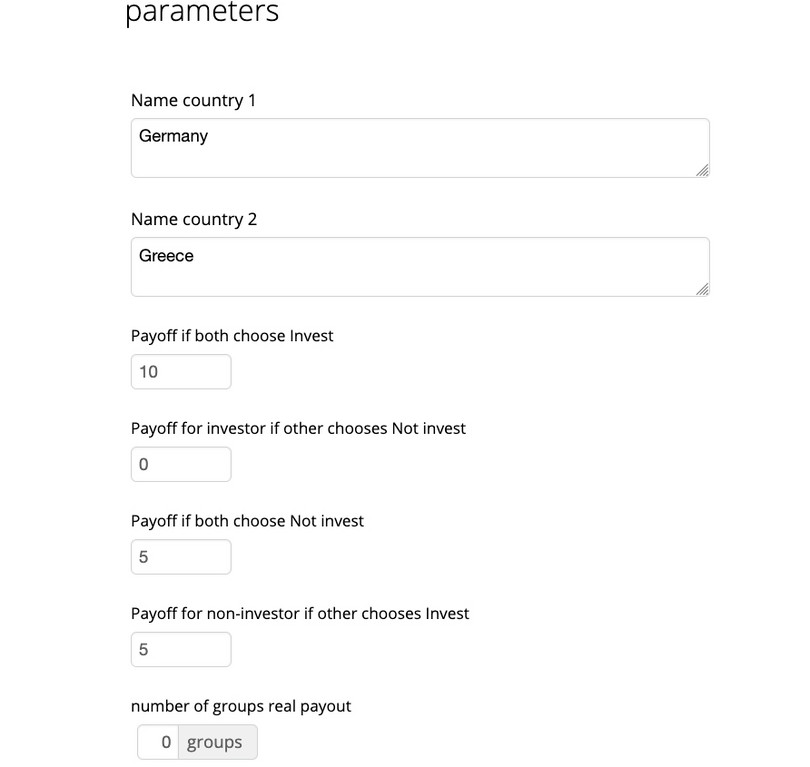
Figure 3.1 Default values of the classEx parameters. See the ‘Parameters’ section for a detailed explanation.
Remember not to tell students that there are two different scenarios. Just make sure they are aware of the additional information on the screen of their personal device. Emphasize that they should not talk to each other and should only look at their own screen.
-
Once your students are logged into classEx, provide them with the student instructions in Section 3.5.
(Note that these are also available in the students’ version and can be distributed beforehand.)
The instructor’s screen displays a summary of the instructions and can be used to explain the experiment (Figure 3.2). Emphasize that students are not allowed to communicate with others. Explain the instructions and announce that they will have around one minute to submit their decision.
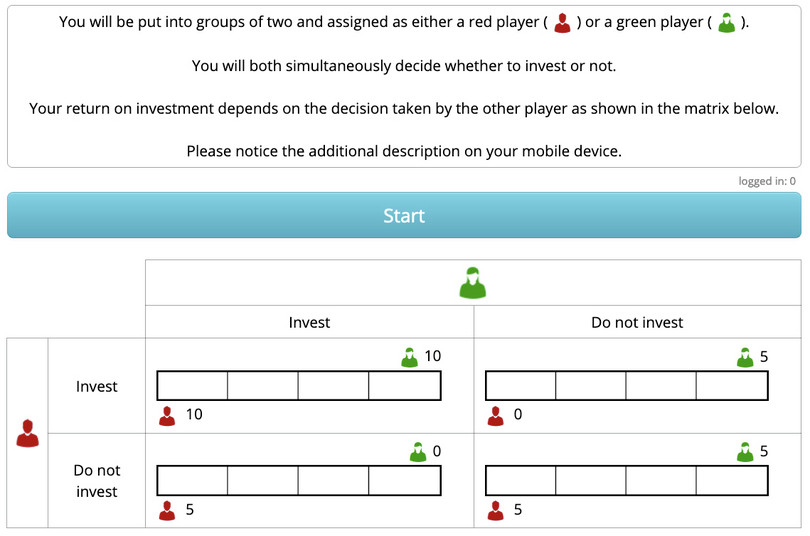
Figure 3.2 Instructions for the game, as displayed in the instructor’s screen on classEx.
- Ask if there are any questions. Then start the experiment by clicking the ‘Start’ button. Students’ devices will show a screen similar to that in Figure 3.3.
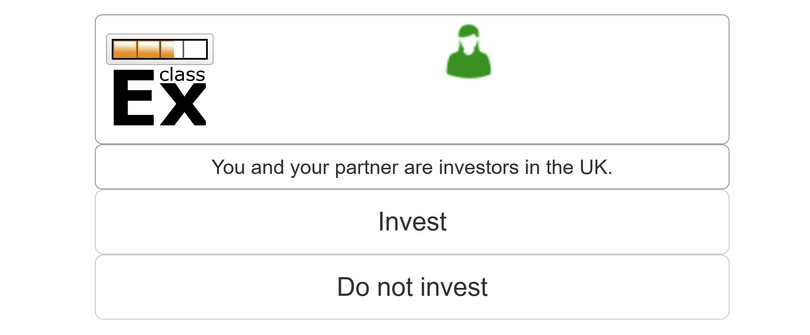
Figure 3.3 Student decision screen.
- Give students around one minute to submit their decision. Then end the experiment by clicking the ‘Results’ button. Students will receive feedback as in Figure 3.4 on their devices. Make students aware that they should check their screen for the results.
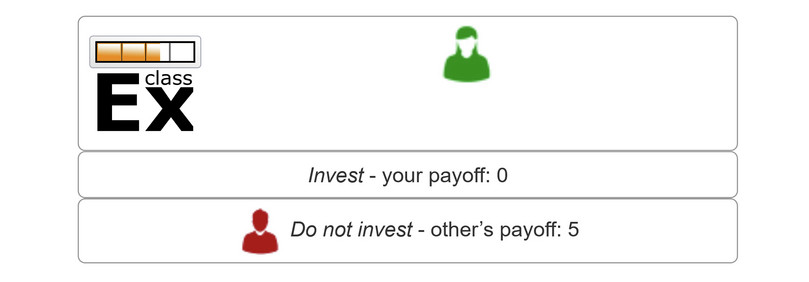
Figure 3.4 Feedback after the experiment for a student who invested and got 0 as payoff. The other player in the team did not invest and got a payoff of 5.
Reveal now that there were two different scenarios and that half of the groups were framed to be investors in one country while the other half were investors in another country.
- Display the results matrix on the instructor’s screen, showing the percentages of choices. For more information on how to read the matrix see the ‘Predicted results’ section. Start the discussion.
Quick summary
This section is intended for instructors who have previously run the experiment and only need a brief reminder of the instructions to get them going. It assumes that your students are already logged into classEx and ready to start the experiment.
- Check that the parameters are set according to your preferences. Figure 3.1 shows the default values.
- Explain the instructions to your students (see Section 3.5 or the students’ version) and ask if there are questions. Remind students that decisions are personal and that talking to each other is not permitted. Do not mention that there will be different country names involved.
- Run the experiment:
- Click the ‘Start’ button. Give students approximately one minute to submit their decision.
- End the round by clicking the ‘Results’ button. Students receive feedback on their earnings.
- Show the results graph, reveal that there have been two countries involved and start the discussion as outlined in Section 3.7.
3.5 Student instructions
These are also available in the students’ version.
A PDF of the student instructions and homework questions is also available.
Please note that the payoffs are based on the standard parameters. If you intend to change the payoff parameters you will need to adapt the instructions. If you only want to change the country names you can use the student instructions provided here.
You will be put into groups of two and assigned as either a red player (the red player  ) or a green player (the green player
 ). You will both simultaneously decide whether to invest or not. Your return on investment depends on the decision taken by the other player as shown in the matrix in Figure A.
Rows show the available options for the red player , and columns the available options for the green player . The cells show the respective payoffs for both players according to their decision. For example, in the first row and first column you can find the payoffs if both invest. The following combinations are possible:
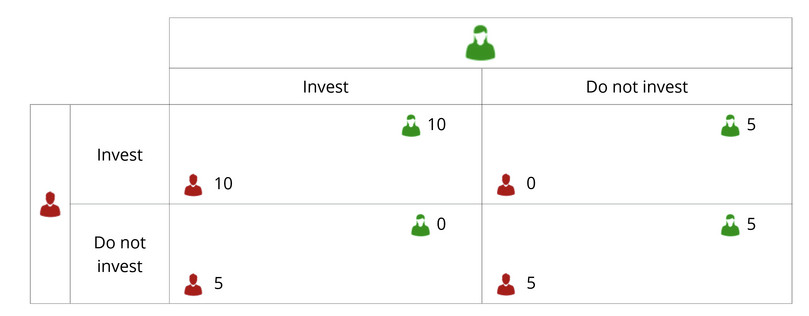
Figure A Matrix summarizing the payoffs.
- If the red player
![]() and the green player
![]() both invest, both get 10.
- If the red player
![]() and the green player
![]() both do not invest, both get 5.
- If the red player
![]() invests, but the green player
![]() does not, the red player
![]() gets 0 and the green player
![]() gets 5.
- If the red player
![]() does not invest, but the green player
![]() does, the red player
![]() gets 5 and the green player
![]() gets 0.
Once the experiment has been started, the decision screen appears on your device (see Figure B for an example). In the top row, you can see whether you are the red player or the green player . You can make your decision by pressing the button ‘Invest’ or ‘Do not invest’. The decision is executed immediately so think carefully before making your decision.
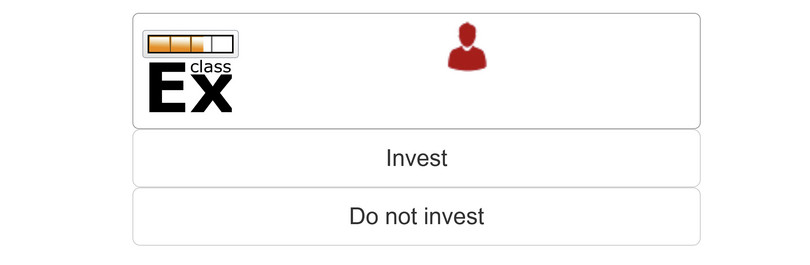
Figure B Decision screen
Once all participants have made their decision, the instructor ends the experiment and the feedback is shown on your screen. Figure C shows an example.
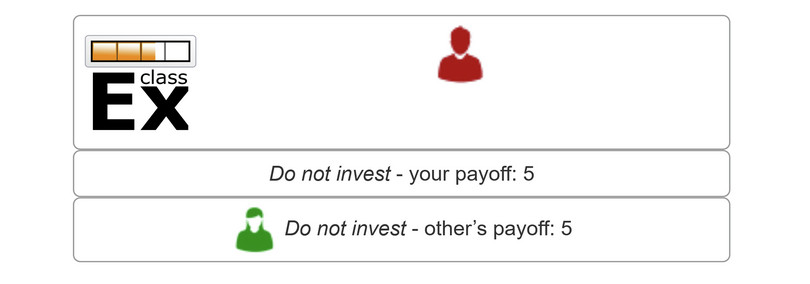
Figure C Example of a feedback screen when no player invests.
In Figure C, you can see your decision in the first row (for example, here ‘Do not invest’) together with your payoff. In the second row, you can see the decision and the respective payoff of the other player.
How to interpret the payoffs
Here we provide some information on how to interpret the payoffs, but you can skip this information as it is not necessary to play the game.
The payoffs in the game can be justified by thinking of two firms who want to invest into a new technology that will only be successful if both firms invest. Otherwise there will not be enough demand for the new product nor will it be worth building up the infrastructure to deploy the products. They have an endowment of 5. If only one firm invests but the other does not, the product is not successful and the firm who invested loses its endowment. The firm therefore ends up with a payoff of 0. The firm who did not invest keeps its original endowment of 5. The same is true if they both keep their endowment.
3.6 Predictions
Predicted results
At the end of the experiment, you will see the results within the decision matrix. You can expect to obtain something similar to the graphs in Figure 3.7, which show the results from the reference example in classEx: an experiment run with a class of 540 students at the University of Passau (Germany) in 2020.
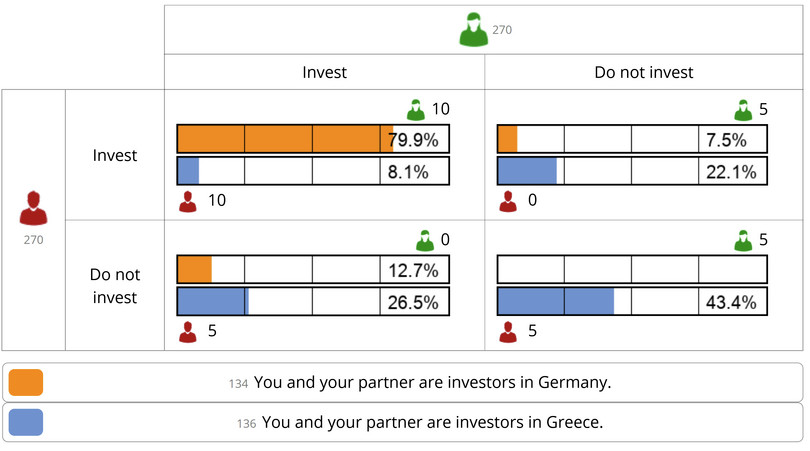
Figure 3.7 Results matrix in a session run with 540 participants at the University of Passau on 29 June 2020.
Figure 3.7 shows the percentage of groups who opted for each combination of decisions. The percentages are shown separately for each scenario. In one scenario, both participants were told they were investors in Germany (orange, shown top). In the other scenario, they were told they were investors in Greece (blue, shown bottom).
In the Germany scenario, 79.9% of the groups coordinated on joint investment, and there were no groups who coordinated on not investing. The remaining 20.1% (= 12.7% + 7.5%, difference due to rounding) mis-coordinated as one participant invested while the other did not. The result is very different in the second scenario (Greece), where 43.4% of the groups coordinated on not investing. Only 8.1% managed to jointly invest, while almost half of the participants (22.1% + 26.5%) mis-coordinated.
Theoretically, the two Nash equilibria of the game are Invest–Invest and Not invest–Not invest. The selection of which equilibrium prevails is influenced by the framing given in the scenario, namely, the name of the country. At the time of the experiment in Figure 3.7, participants were expected to associate Germany with a strong infrastructure (even if investments had been subdued in the recent past), while they most likely considered Greece as not providing the optimal circumstances for joint investment. It has to be highlighted that this is all about perceptions, and it does not say anything about the investment opportunities in either of the countries. In the game, payoffs (and therefore investment opportunities) are the same in both countries. The difference stems from the fact that the information that the player is an investor in Germany can be used as a signal to coordinate expectations. The information is common to both partners in the game so that they can assume the other received the same information and made similar conclusions from that (first-order expectations). In theory, a player could go even further by knowing that the partner knows that the player read the same information (higher order expectations). This common information is also called a focal point, that partners can coordinate on. It is much easier to use this salient piece of information (the country in our case) to coordinate on a strategy than to coordinate by first and higher-order expectations, that is, each player thinking what the other player may think that they are thinking.
The results are further confirmed by a version of the game that was run in June 2016 right after the Brexit referendum. The results of the session at the University of Passau (Germany) can be found in Figure 3.8.
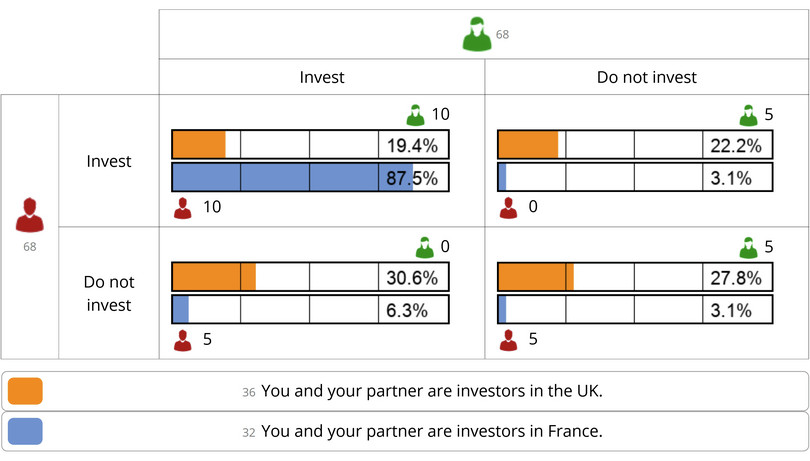
Figure 3.8 Results matrix in a session run with 134 participants at the University of Passau on 27 June 2016 right after the Brexit referendum on 23 June 2016.
While participants coordinated on investing in France, they failed in the UK. At the time the game was played, June 2016, the UK had just decided to leave the European Union and the future was highly unclear, which is commonly associated with bad investment circumstances. Being an investor in the UK did not work anymore as a signal to coordinate in investing.
All these observations provide good grounds for an active in-class discussion where students reflect on their behaviour and their expectations about the behaviour of others. You can follow the list of questions in Section 3.7 to guide your discussion, and read the experiences of other instructors provided in Section 3.10.
What might go differently?
As in any coordination game with multiple equilibria the results are context dependent and can be easily influenced by any form of public announcement. Therefore, it is important not to allow any communication during the experiment. The treatment effect between the two countries is even stronger if the scenario is not pre-announced and students are not aware of the different scenarios. Therefore, if the game is played in a lecture hall it is important to highlight to students that they should decide on their own and should not look at their neighbours’ screens. If the game is played during an online session, it may be good to deactivate the chat option during the running of the experiment (this is possible in many of the standard video conferencing systems).
One crucial decision is the set of countries to be chosen. The results shown in Figure 3.7 are from a session run in Germany. While there might be a certain home country bias, the results in Figure 3.8 suggest that it is not driving the effect. Still, it might be good to choose countries that students can connect to. In addition, perceptions about the countries’ investment conditions should not be so similar (for example, Germany vs Austria) that it is difficult to get a treatment effect. It could be useful to choose a pair of countries from Figures 13.19a and 13.19b in The Economy 1.0 (US vs Mexico or UK vs South Africa).
If you play the game with a small number of groups (<10 participants), there may be no treatment effect or a reverse treatment effect. In this case, you can use the previous results in classEx to show standard behaviour in sessions with a lot of participants.
Finally, if avoiding communication among students is challenging, you can slightly speed up the pace by reducing the time the students are given to make decisions.
3.7 Discussion
A good discussion following the experiment is important. Ask your students the following questions to frame the discussion.
Interpreting the graphs
Comments in the ‘What might go differently’ section provide useful further information.
- Describe how the matrix can be read.
- Describe the difference between the results in the two countries.
- Explain whether we can safely combine the results in the bottom left cell with the top right cell.
You can use this to highlight the symmetry of the game.
Reflecting on the decisions that players made
- What drove your decision?
- Describe the role of your expectations about the other player.
- Describe your thoughts when you read the additional instruction that you and your partner are investors in a specific country. Did your ideas about this country influence your decision? What did you think your partner would think?
Link to theory
- Describe the Nash equilibria in this game. Is there one or are there more?
- Is one equilibrium preferable to the other? What can be a criterion to select one of them?
Here you can talk about the welfare aspects of the different combinations and the Pareto criterion.
- Does the additional information about the location of investments influence the theoretical solution?
You can introduce concepts like focal points here if you want to use the results to explain game theoretic concepts.
- What can we say about the role of expectations?
- Comment on this statement: It is not only important to think about the way the other will think, but also to think about what the other thinks of how I think.
Higher order expectations open up an advanced discussion which can be used to stimulate students’ interest.
Relating the experiment to real life
- Why is it important for a firm to know that another firm invests as well?
Here you can relate to standard reasons like the role of infrastructure investments or minimum quantities to generate enough demand. You can also discuss the role of transaction-specific investment. The more other firms use the same technology, the easier it is to resell the investment again.
- Why do firms make losses if they are the only ones that invest in a specific technology?
- Name some examples that relate to a similar situation as in the game.
This is a good point to introduce examples such as adoption of new technologies. Observe that the game between Plugcar and Netflex in Section 21.3 of The Economy 1.0 (Figure 21.7) represents another incarnation of the game played in this experiment.
- How can the experiment help to explain the spread of optimistic or pessimistic mood?
- Compare your results to Figure 13.19a in The Economy 1.0. Are there any parallels?
A hypothetical situation
- Assume a student stood up during the experiment and explained how good it is to invest in Greece. How would this affect the results?
Critical evaluation of the experiment
- Does this experiment say something about the true investment conditions in the two countries?
It is very important to show that the experiment is not about assessing investment conditions in different countries, but exclusively about common perceptions. This is especially important if you use the country you are teaching in as one of the scenarios.
- What other criteria can influence the investment decisions in reality?
- Is it reasonable to assume that participants decide simultaneously in the real world?
Here you can discuss the role of sequential moves in reality, but also highlight that firms operate secretly without other firms knowing what they actually develop.
3.8 Homework questions
These questions can be set for students to work on outside the classroom or can be completed and discussed in the classroom. They may help students reflect on their experience and understand their and others’ behaviour in the experiment.
For question 2, you have to share a screenshot of the results screen with your students. If your results screen does not show the predicted results, you can use Figure 3.7 and share it with the students.
Data from your experiment can be downloaded as an Excel file from the ‘data’ menu in the instructor’s screen in classEx. You can use this data to create your own questions. A description of the data variables can be found in the ‘Downloading the data from your experiment’ section.
The following text is also available in the students’ version.
- Explain the following concepts, referring to your experience from the game played in class:
- Multiple equilibria in a coordination game.
- How the attractiveness of investments depends on the investments of others.
- The role of expectations in decision making.
- Your instructor shared with you the results for the investment game that you played.
- What equilibria are there in the game? How do expectations regarding the other player’s decision affect one’s own investment decision?
- In the lecture, the participants were given private information. This information does not change the payoffs in the game. Nevertheless, it turns out that investments are more frequent in some circumstances. Explain this result. How can the results help to explain that investments are volatile in an economy?
- Critically discuss the fact that the game has been run in your home country.
- Figure D (Figure 13.17 from The Economy 1.0) shows the payoffs in an investment game.
- Explain how the payoffs in the game relate to the investment decisions of two firms.
- What are the Nash equilibria in the game? Define the concept of Nash equilibrium as well. How do expectations regarding the other player’s decision affect one’s own investment decision?
- Given your experience of the game in class, how would the theoretical solution differ from the expected outcome if the game were played by students?
- Imagine the game is played with a value of 10 instead of the −40. What changes do you expect in the behaviour of participants? Why?
- Describe other factors, besides the investment decision of other firms, that investment decisions are based on.
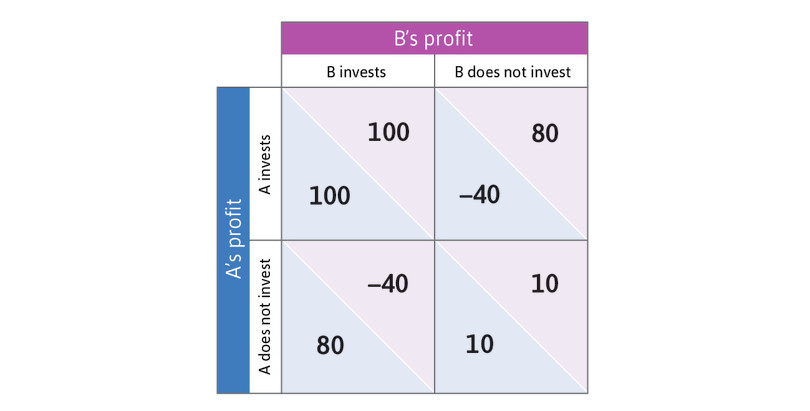
Figure D Figure 13.17 from The Economy 1.0, showing payoffs in a coordination game.
- Think back to the investment game that you played in class.
- What factors can help to stabilize investment decisions within a country?
- What is the role of the government and of industrial representatives here?
3.9 Further reading
Also available in the students’ version.
- Akerlof, George A. and Shiller, Robert J. Animal spirits: How human psychology drives the economy, and why it matters for global capitalism. 9th edition. Princeton University Press, 2010, pp. 131-148.
- Barrera, Cathy. Blockchain and Coordination Games: Failures and Focal Points. 2018.
- CORE The Economy 2.0: Microeconomics, Section 4.13.
- CORE The Economy 1.0, Sections 13.7, 4.13 and 21.3.
- CORE Economy, Society, and Public Policy, Section 3.12.
- Mielke, Jahel and Steudle, Gesine A. Green Investment and Coordination Failure: An Investors’ Perspective, Ecological Economics, 150, 2018, pp. 88-95.
- Carlin, Wendy and Soskice, David. Macroeconomics: Institutions, Instability, and the Financial System. Oxford University Press, 2014, pp. 29-32.
3.10 Instructor experience
In this section, we hear from instructors about their experience of running the experiment with their students.
Johann Graf Lambsdorff University of Passau, Germany
I use the investment game in principles and intermediate courses in macroeconomics. It fits well in a chapter on individual investment behaviour, for example related to the marginal returns to capital or the internal rate of return, prior to deriving the negative impact of the (real) interest rate on aggregate investment and aggregate demand. It alerts students to the many complexities that surround investment decisions and environmental influences for which expectations are difficult to form. In particular, it reveals how decisions to engage in investment can be dependent upon other investors engaging as well. By doing so, it shows how an investment climate contributes to levels of investment and how fragile this climate might be.
Investors decide simultaneously on whether to invest or not. An investment is attractive only if others invest as well. An investment thus requires coordination among many players. This coordination rests on investors’ beliefs. If confidence is high that others will invest as well, this becomes self-perpetuating, fostering an environment where all will prefer to invest. If investors worry that others might abstain from an engagement, they prefer to abstain as well and this results in low levels of investment on average.
The investment game provides lecturers with a convenient method for proving the fragility of the investment climate with the help of a framing effect. Lecturers can confront one treatment group with the frame that they invest in a country with a strong investment climate and another control group which invests in a country with an adverse investment climate. Differences between these treatments tend to be strong. For example, in 2016 shortly after the referendum about Brexit, I confronted students with two different countries: They were either investors in the UK or in France. The striking results were that 75% of participants coordinated on investing in France but only 25% did so in the UK. This showed the strong influence of major political shifts on the willingness to invest.
Marcus Giamattei Bard College Berlin, Germany
I use the investment game both in macroeconomic classes as well as in behavioural economics classes. The game is sufficiently simple to be played both without and with macroeconomic background information. The beauty of the game stems from the fact that students are not informed about the treatment beforehand and that the results have worked throughout the last six years that we played the game. Overall, we had over 1,400 participants playing the game. And the results are always clear and impressive. The students can be motivated and surprised by their own decision behaviour and how a simple framing like being investors in Germany can help to improve coordination. The destructive nature of an uncertain environment can also be motivated clearly. The nice feature of the game is the between-subject decision which allows instructors to run both frames at the same time. The results are simple and easy to interpret (once you know how to read a game matrix).
In macroeconomics, instructors can include the game in a discussion about the determinants of investment behaviour which goes beyond the simple analysis of net present value, interest rates, and earning expectations. It allows instructors to include the role of herding and the spread of optimistic and pessimistic moods. You can also easily explain the complementary nature of investments in a macroeconomic setting, which drives the business cycle.
In a behavioural economics class, the game can also be used to discuss the role of framing which does not influence payoffs. Beyond the motivation to learn the dynamics of coordination games, it allows the instructor to introduce the concept of focal points. More advanced discussion can also dive into the role of higher order expectations and how the cycle of higher order expectations can be broken with such focal points. An even more advanced discussion can connect to the role of sunspots in coordination games with multiple equilibria.
This is what makes the game so useful as it is simple in nature but allows any type of class discussion suited for the respective level of the class.
